
Running Physical Therapy in Davidson, NC
You don't just want the pain to stop.
You want to run again.
Whether you're training for your first 5K, preparing for a marathon, returning after an injury, or trying to solve pain that keeps returning every time your mileage increases, Return 2 Play evaluates both the injury and the way you run.
Running Injuries We Commonly Evaluate
-
Runner’s knee can cause pain around or behind the kneecap, especially during running, squatting, stairs, or prolonged sitting. A running-focused physical therapist can identify contributing factors and build a plan to improve strength, mobility, and running mechanics.
-
Hip pain can develop from overuse, muscle weakness, mobility restrictions, or changes in running volume. Physical therapy can help determine the source of your pain and address the underlying factors affecting your stride.
-
IT band-related pain often causes discomfort on the outside of the knee or hip, particularly during running. Treatment may focus on hip and lower-extremity strength, running mechanics, mobility, and gradually building tolerance to running.
-
Achilles tendon pain can develop when the tendon is exposed to more running load than it can currently tolerate. A structured rehabilitation program can help gradually restore calf strength, tendon capacity, and running tolerance.
-
Pain underneath the heel or through the bottom of the foot can make running uncomfortable and may worsen with increased mileage. Physical therapy can address foot and ankle strength, mobility, load management, and running mechanics to help you return to activity.
-
Shin pain is common when running volume, intensity, terrain, or frequency increases too quickly. Proper evaluation can help determine whether the pain is related to muscular overload, bone stress, or another condition and guide an appropriate return-to-running plan.
-
Hamstring strains and recurring hamstring pain can interfere with speed, distance, and confidence while running. Rehabilitation typically focuses on restoring strength and control while progressively preparing the hamstring for the demands of running.
-
Calf strains can occur when the muscle is overloaded during running, sprinting, hills, or changes in training. Physical therapy can help restore calf strength and capacity while gradually progressing you back to running.
-
Not all knee pain has the same cause, and continuing to run through pain without understanding what is contributing to it can make recovery more difficult. A physical therapist can assess your strength, mobility, movement patterns, and training load to develop an individualized plan.
-
Running-related overuse injuries often develop when training load increases faster than your body can adapt. Physical therapy can help identify the factors contributing to the injury while building your capacity to handle the demands of your running goals.
-
Getting back to running after surgery requires more than simply waiting for pain to go away. A progressive rehabilitation plan can help rebuild strength, mobility, impact tolerance, and confidence before you return to your previous running volume.
-
Returning to running after pregnancy should be a gradual process that accounts for changes in strength, pelvic floor function, core control, and overall load tolerance. A postpartum physical therapist can help you safely progress from foundational strength and impact exercises back to running.
How we help Runners
Running injuries rarely come down to one muscle or one joint. We look at your training history, strength, mobility, running mechanics, recovery, footwear, goals, and recent changes in mileage or intensity to understand what may be contributing to your symptoms.
Running Physical Therapy
Get to the root of pain or injury and build back to running safely.
Running Gait Analysis
Video analysis of your running mechanics combined with strength and movement testing.
Strength & Performance Testing
Identify strength deficits, asymmetries, and movement limitations that may affect running.
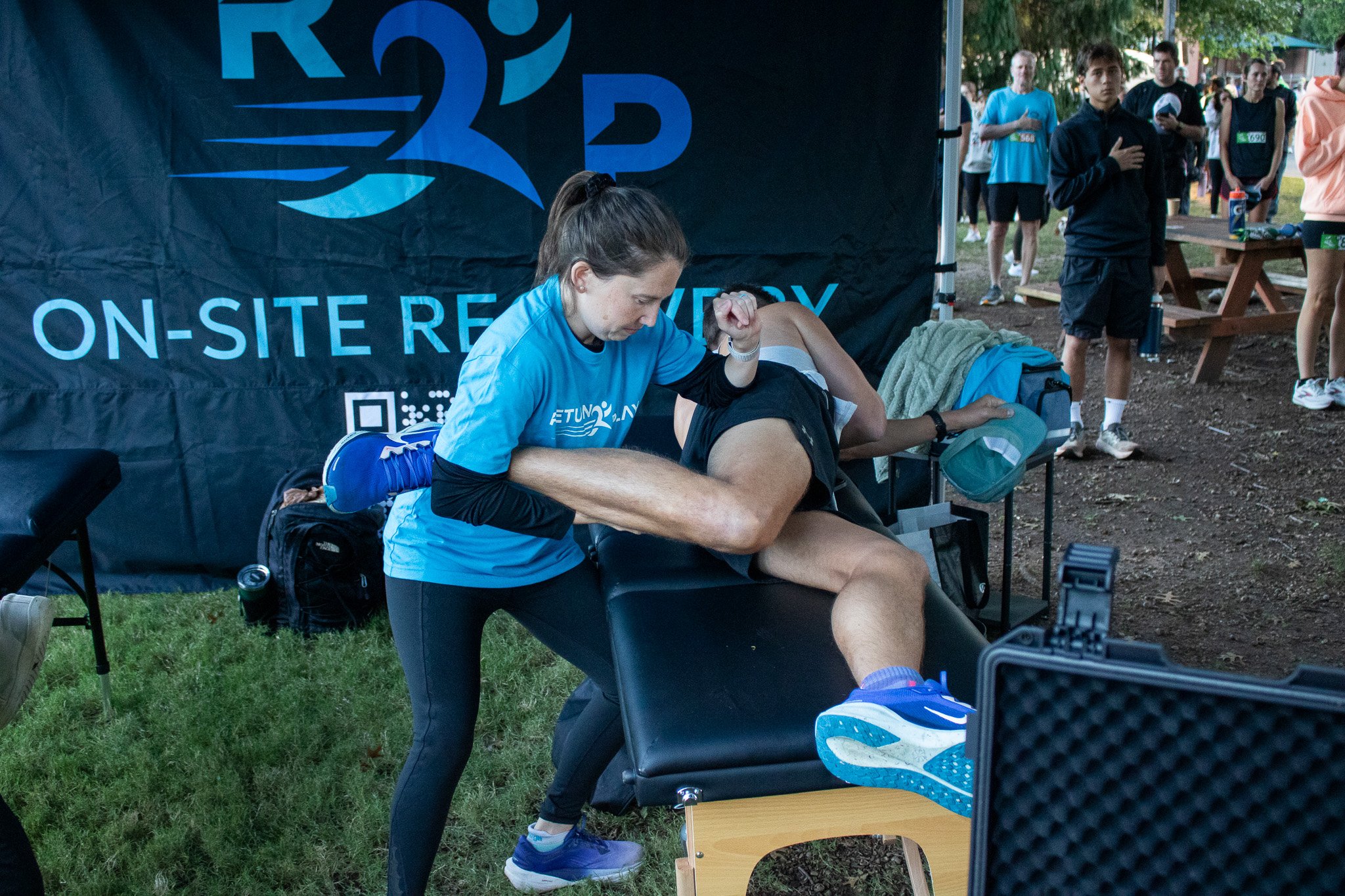
Sports Massage & Recovery
Hands-on care to support recovery, mobility, and training.
| Evaluation Area | What We’re Looking At |
|---|---|
| Injury & Training History | Previous injuries, surgeries, symptoms, and your running background. |
| Weekly Mileage | Current running volume, frequency, long runs, and intensity. |
| Recent Training Changes | Changes in mileage, pace, hills, terrain, or race preparation. |
| Strength & Mobility | Feet, ankles, calves, knees, hips, and core. |
| Running Mechanics | Movement patterns and factors relevant to your symptoms and goals. |
| Video Analysis | A closer look at running mechanics when appropriate. |
| Footwear & Environment | Shoes, surfaces, terrain, and other relevant training factors. |
| Pain Response | When symptoms occur and how they respond during and after running. |
| Goals & Upcoming Races | Your performance goals, upcoming races, and desired timeline. |
| Return-to-Running Plan | A progressive strategy to safely build running volume and intensity. |

Running Physical Therapy in Davidson, NC
Return 2 Play works with runners throughout Davidson, Cornelius, Huntersville, Mooresville, and the Lake Norman area. From first-time 5K runners to marathoners and competitive endurance athletes, our Davidson clinic provides running-specific physical therapy, gait analysis, strength testing, and return-to-running care designed around your goals.

Frequently Asked Questions
-
Our $79 Running Evaluation is a focused, 30-minute session designed for runners who want a quick look at their running mechanics.
It includes:
Video analysis of your running form
1–2 targeted strength measurements
Discussion of key findings and areas that may be affecting your running
This option does not include treatment or a personalized exercise program. It is best for runners who are generally healthy, are curious about their running form, or want to identify potential areas to work on before they become bigger problems.
A full Physical Therapy Initial Evaluation is the better choice if you are currently dealing with pain, an injury, recurring symptoms, or a more complex problem.
During a full evaluation, we have more time to assess your strength, mobility, movement patterns, injury history, training demands, and other factors that may be contributing to your symptoms. Treatment may also begin during that visit, and you will leave with an individualized plan for what to work on moving forward.
-
Choose the $79 Running Evaluation if:
You are not dealing with a significant injury
You want feedback on your running form
You are interested in video gait analysis
You want a quick snapshot of a few strength or movement factors
You do not need treatment or an exercise program that day
Choose a Full Physical Therapy Initial Evaluation if:
You are currently running with pain
An injury is limiting your mileage, speed, or training
The same problem keeps coming back
You recently had surgery or a significant injury
You want treatment during the visit
You want a personalized rehabilitation or exercise program
You need a more comprehensive assessment of why the problem is occurring
Still not sure? Contact our team and tell us what you are experiencing. We can help you decide which appointment is the best place to start.
-
Yes. Return 2 Play provides running physical therapy and running gait analysis in Davidson, NC for runners throughout Davidson, Cornelius, Huntersville, Mooresville, and the Lake Norman area.
We work with runners of all levels — from someone preparing for their first 5K to experienced distance runners — and tailor care around your injury, training demands, running mechanics, and goals.
-
We work with runners experiencing a wide range of injuries and recurring problems, including runner's knee, knee pain, shin splints, Achilles tendon pain, plantar heel and foot pain, IT band pain, hip pain, hamstring and calf injuries, ankle injuries, and other overuse conditions.
Rather than only treating where it hurts, we also look at factors such as strength, mobility, training changes, previous injuries, and running mechanics that may be contributing to the problem.
-
Running physical therapy combines traditional orthopedic physical therapy with an understanding of the specific demands of running.
In addition to evaluating the injured area, we may assess running mechanics, strength, mobility, training history, mileage changes, recovery, and the physical demands of your running goals.
The goal isn't simply to help you feel better during everyday activities — it's to help prepare your body to return to running confidently and tolerate the demands of training.
-
Absolutely. You don't have to be injured to benefit from a running gait analysis.
Runners may choose an assessment to better understand their running mechanics, strength, movement patterns, or areas of asymmetry, especially when increasing mileage, training for a race, or working toward performance goals.
If you're currently experiencing significant pain or an injury, however, a full physical therapy evaluation is usually the better place to start so we can perform a more comprehensive assessment and provide treatment and an individualized program.
-
Yes. Returning to running often requires more than simply waiting until pain improves.
Depending on your injury and stage of recovery, we may assess strength, mobility, impact tolerance, movement quality, and running mechanics before gradually progressing your running volume and intensity.
Our goal is to help you move from rehabilitation back to running with a clear plan rather than guessing when you're ready.
-
Our goal is usually to help you stay as active as safely possible while your injury heals. In many cases, that means modifying your running, lifting, mileage, intensity, or specific exercises rather than stopping everything altogether.
We’ll look at your symptoms, strength, movement, training demands, and the type of injury you’re dealing with to determine what you can safely continue doing and what may need to be adjusted temporarily.
We don’t believe in automatically shutting athletes down just because they have pain.
The goal is to keep you moving, protect the injured area, and build you back toward full training as efficiently and safely as possible.
-
Return 2 Play is a cash-based physical therapy practice, which allows us to spend your visit focused on you — not on insurance restrictions, visit limits, or what a plan will and won’t authorize.
Our goal is to help you become independent as quickly as possible, not keep you coming to therapy longer than you need to. Because visits are one-on-one and include a personalized plan for what you can work on between sessions, we focus on making each appointment as useful as possible and avoiding unnecessary visits.
Many patients are also able to use HSA or FSA funds toward eligible physical therapy expenses. If you have out-of-network benefits, you may also be able to submit your visits to your insurance company for reimbursement depending on your plan.
We do accept traditional Medicare for eligible physical therapy services.
Have questions about cost, HSA/FSA use, or out-of-network reimbursement? Contact our team before scheduling and we’ll help you understand your options.